How to use this
- Skim the review. Watch the real ASL videos (YouTube teachers, not AI).
- Flip the Vocab cards until the signs and culture facts feel easy.
- Take the Practice quiz (10 questions — closer to a lesson-quiz length). It is still practice, not the live Canvas quiz.
I cannot see you sign. Use the course videos or ask Scott if you want feedback on how a sign looks.
Numbers 1–10
The lesson pictures show numbers the way the other person sees them.
Found on YouTube: Learn How to Sign, “How to Sign Numbers in ASL.” Starts at the 1–5 teaching tip.
Five parameters
If one piece is wrong, the whole sign is wrong — you may be signing a different word.
Lesson examples:
- CHAIR vs SIT — same hands, different movement (double tap vs one tap).
- SCHOOL vs PAPER — same hands, different movement (double tap vs brush back).
Found on YouTube: ASL THAT, “5 Parameters of ASL.”
Culture facts the quiz likes
Sign language is not universal
Not every Deaf person uses sign language, and not every signer knows ASL. Other languages include British Sign Language (BSL), Irish Sign Language, French Sign Language, and Auslan (Australia).
Oralism
In the late 1800s people argued: should Deaf students use sign language or speech training? Alexander Graham Bell pushed students to lipread and speak. Many schools adopted oralism and banned signing.
- Oralism = speech + lipreading as the main way to communicate. It takes years of hard training.
- Students practiced by feeling vocal vibrations on the throat and repeating facial movements.
- A huge myth: “all Deaf people can read lips.” Lipreading is only about 30% accurate. People fill gaps with context and knowing the speaker.
NAD
Around 1880 the Deaf community founded the National Association of the Deaf (NAD) — by and for Deaf people. Goal: preserve ASL, gather on important issues, and have a national voice. Former NAD president George Veditz later filmed Preservation of the Sign Language.
Deaf vs deaf
- Deaf (capital D) = culture: beliefs, values, community.
- deaf (lowercase) = medical hearing loss.
- All Deaf people are deaf, but not all deaf people are Deaf.
Signing space + the dialogue
The space in front of the signer shows distance, time, and contrast (places, people, ideas).
Friendly conversation clues: facial expressions, body language, and gestures — not just the signs.
In the lesson video: the girl’s name is Ashley. The boy keeps asking for her phone number.
Vocab you will be tested on
These are the lesson’s assessed signs. Details are on the Vocab tab. Watch a real teacher demonstrate a bunch of them:
Found on YouTube: Learn How to Sign, “30 Basic ASL Signs For Beginners.” Includes the 5 parameters tip, nice to meet you, thank you, hearing, yes, no, understand, slow, please.
Slow and steady (beginner signs)
- WORD — G taps on non-dominant index (1).
- SLOW — flat hand slides slowly up the other arm. NMM: “oo” mouth.
- AGAIN — bent-B flips down into the other palm.
- NUMBER — two flat-O hands rotate (palms swap in/out).
- UNDERSTAND — S at temple flicks to 1, head nod. For DON’T-UNDERSTAND, shake your head instead.
Pleased to meet me
- NICE — flat hand slides forward across the other palm.
- MEET — two index fingers come together (two people meeting).
- DEAF — index: ear then chin (some signers reverse it).
- HEARING — index circles small in front of the mouth.
- LEARN — pick up from the palm (5 → flat O) and put it at the forehead.
Found on YouTube: ASL LOVE, “How to Sign — NICE TO MEET YOU.”
Polite / everyday
- ASL — fingerspelled #ASL.
- SIGN LANGUAGE — SIGN (index fingers circle toward you) + LANGUAGE (F hands flip out). Beginners may use pinkies for SIGN.
- PLEASE — flat hand circles on the chest.
- YES — S-hand nods (like a head). Nod your real head too.
- NO — first two fingers tap the thumb (like N+O). Shake your head.
- THANK YOU — flat hand from the mouth/chin, forward. Two hands = extra grateful.
Found on YouTube: ASL LOVE, “Sign the words PLEASE, THANK YOU and YOU’RE WELCOME.”
Phrases + NMM
- Yes, I am learning to sign. YES SIGN-LANGUAGE IX-I LEARN — nod on YES; eyebrows up on SIGN LANGUAGE.
- Are you deaf? IX-you DEAF IX-you — eyebrows up the whole time (yes/no question).
- No, I am not deaf; I am hearing. NO IX-I DEAF (headshake) IX-I HEARING — shake on NO; nod on HEARING.
- What is your phone number? POSS-your PHONE NUMBER WHAT — eyebrows up on YOUR PHONE NUMBER, furrowed on WHAT.
- My phone number is… POSS-my PHONE NUMBER + digits — eyebrows up on MY PHONE NUMBER; all digits palm out.
Fingerspelling stills (Wikimedia, not AI)
Public-domain ASL letter drawings. #ASL is just A, S, L fingerspelled.
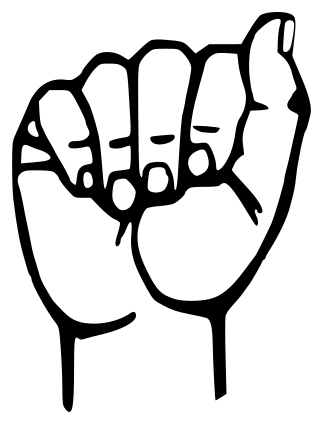
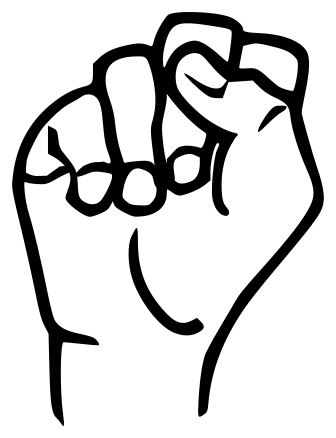
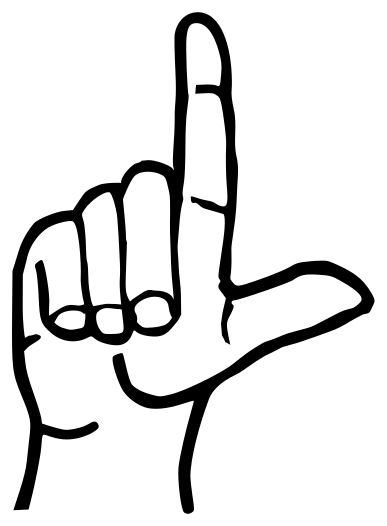
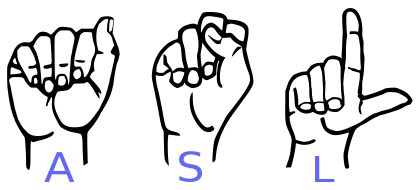
Images from Wikimedia Commons / WP Clipart (public domain). Photo of number 1 on the quiz is also Wikimedia — a real person, not generated.
Tap a card to flip it. These are the lesson’s assessed words plus the culture facts quizzes usually ask.